Listen to us on Spotify:
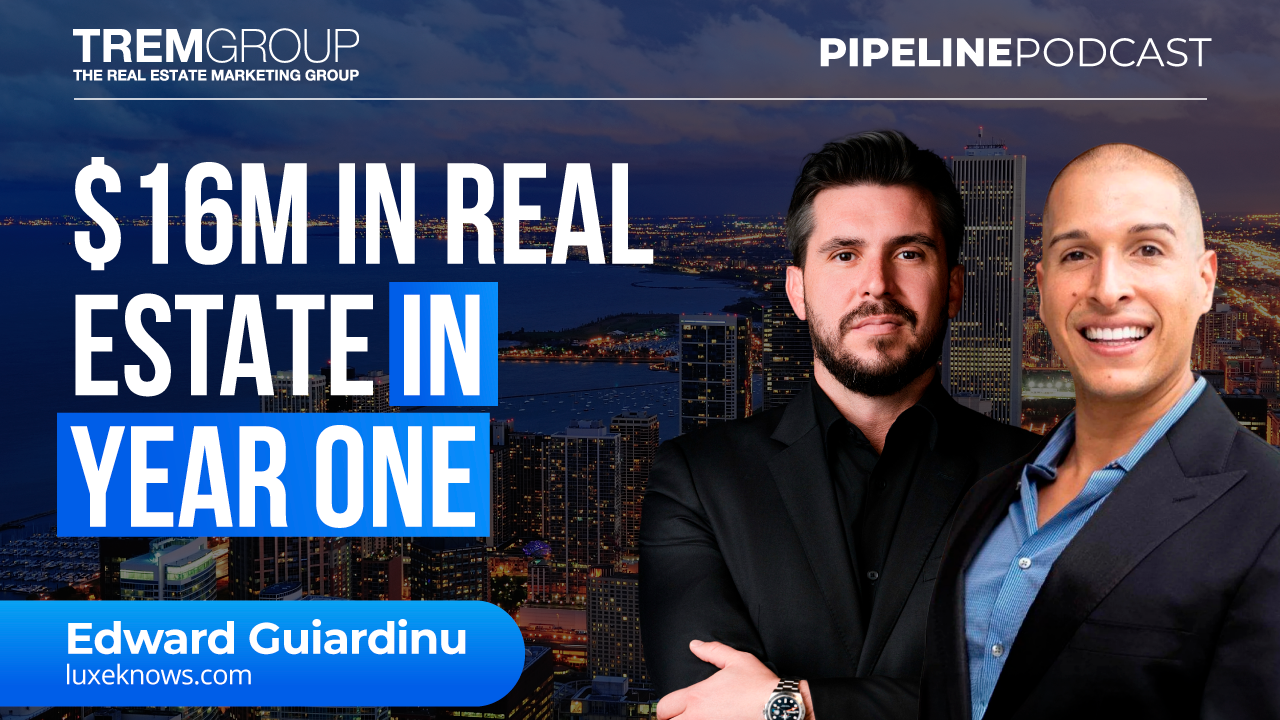
Are you actually a top producer, or are you just the best-kept secret in your market? In this latest episode of The Real Estate Pipeline, Carlos Concepcion sits down with luxury powerhouse Edward Guiardinu to dissect the heavy price agents pay for digital invisibility.
While most realtors waste years waiting for their phone to ring, Edward breaks down the aggressive shift toward a hyper-targeted real estate branding setup designed to attract high-net-worth clients before you even shake their hand.
The conversation goes straight to the front lines of the luxury market, focusing on the massive migration happening right now in prime South Florida neighborhoods. They break down a winning Miami real estate strategy tailored for the modern seller, explaining why traditional single-family homeowners are aggressively downsizing into ultra-exclusive, walkable luxury condos.
If you don’t understand this shift in lifestyle demand and how to price it, you are completely locking yourself out of the city’s most lucrative luxury listings.
Beyond the flashy lifestyle, this episode is a reality check on what authentic execution looks like when the market tests your limits. Edward and Carlos deep dive into the absolute necessity of market adaptability, proving that the future of real estate belongs to those who own their data, dominate their local niche, and build digital infrastructure that scales.
Video full transcription
Carlos: Well, thank you for being here today.
Edward: Thank you, my friend. Thank you for having me.
Carlos: So, for those of you who are joining, welcome to another episode of The Pipeline. This is a podcast where we talk with real estate professionals who are building their personal brands and dominating their markets. And our goal is to provide valuable information and valuable resources for buyers, sellers, and other brokers outside who might not be following what top producer agents like yourself are doing. Amen. Today, I’m very happy to have our friend and partner, Edward Guiardinu.
Edward: Yes. And thanks for having me.
Carlos: Just to give a brief intro, and then I’m going to let you talk about yourself. Edward started in real estate maybe five or six years ago. Within four years, he has become a top producer agent in the Coconut Grove market in Miami, the South Florida market—one of the most competitive markets. He is part of Lux Nos, which is an amazing brokerage, very focused on quality advisory, quality attention to detail, and valuable expertise. Shout out to Wesley, of course, and our fearless leader.
Edward: Yes.
Carlos: And you know, Edward is not only our friend but our partner as well. And I’m very happy to share this space with you today, Edward.
Edward: Thank you for having me.
Carlos: So talk to the people a little bit about yourself. How did you start in real estate?
Edward: So, I started in real estate. Wesley was my friend for many years. She was also a client in my past life as I was a personal shopper with a luxury department store chain. And in ’21, after the pandemic, they changed our commission structure and I thought to myself, “Maybe this wasn’t the best and highest use of my time.” So, after some cajoling and some convincing from Wesley and my husband, I decided to go and get my real estate license, and I started working and signed at Lux in August of ’21. I was very fortunate and grateful to have the mentorship and tutelage of Wesley, and in my first year, I was able to sell $16 million. From there, in ’22, the interest rates decided to nosedive and go to… or excuse me, skyrocket and hit 8%. And when they did, I realized that being a buyer’s agent might not be the best career choice. So, I decided to shift, pivot, and fully focus on becoming a listing agent. So, 2023 was my first year becoming a full-fledged listing agent. And I targeted Coconut Grove specifically, not only because I lived there, but also because I just always wanted to sell there. Even before I started, I’ll never forget asking Wesley, “Please, I just want to sell like X amount and make it.” And now I’m doing that in just a couple of months and making the earnings from it. So, in ’23, I made the shift, became a listing agent, and from there, the proof is in the pudding. I’ve really focused, harnessed my craft, and perfected understanding price per square foot, understanding the key areas in the Grove, understanding the demographic, and really understanding what it is the buyers or sellers are looking for in order to get the property sold.
Carlos: Well, as a resident of Coconut Grove and a top producer in the Coconut Grove market in Miami, how have you seen that market switch in the past 5 years alone?
Edward: So, I think for us Grovites, the biggest takeaway has been just all the construction. So, when you talk about Bayshore Drive or when you talk about 27th Avenue, you see construction going on at the Four Seasons, then you have construction going on at The Lincoln, then adjacent you have The Well being built, and now off of Grand Avenue, they’re working on the Ziggurat. And these are all brand new builds that are going to elevate the Grove. Condos are trading now at… you know, you can get a good condo at $1,000, maybe $2,000 a square foot at the high end on certain buildings like Park Grove or Mr. C’s. And once the Four Seasons is complete, I think it’s going to totally shift that, as the Four Seasons is currently trading at $3,000 to $4,200 a square foot, breaking records. We saw it in Surfside with the completion of the Four Seasons there, that it started to break records, and now everything in that area is trading at a much higher price per square foot. And I think we’re specifically going to see that happen in the Grove. Something also that’s interesting in that little Grove area is between the Ritz-Carlton, Park Grove, Grove at Grand Bay, the Four Seasons, and Mr. C’s, we’re going to have our own little South of Fifth. And it’s just amazing that a couple of years ago, none of that existed. So, for me, being a resident of the Grove of over 12 years, it’s just something that I’m really proud of—to see the evolution and also be a part of it, being able to service clients that are coming in from other parts of the US and internationally, and really give them that insight and detail because I’ve lived it and seen it from a resident perspective and from a lifestyle perspective.
Carlos: For people that are watching all over the world, what is the Coconut Grove lifestyle like?
Edward: The Coconut Grove lifestyle—there’s nothing else like it in Miami because you don’t feel like you’re in Miami when you’re there. It’s a much slower lifestyle compared to other parts of the city, especially because there’s so much walkability. So, if you’re staying somewhere like, for example, the Ritz or you’re at Park Grove, it’s just nice that you can go downstairs and walk to CocoWalk where they have Michelin-rated restaurants, excellent shopping, and excellent bars. There’s so much to do. I like to call it or consider it like a “walking DUI” because there’s so much to do, or you have the pleasure of a short Uber ride—it’s just 3 to 5 minutes and you can get anywhere you need to be in the area. What’s also really nice about Coconut Grove is that it really is a lifestyle and a family area. You’re seeing a lot of the same people over and over again, and there’s a real sense of community there. We can always tell a Grovite versus a non-Grovite because we don’t honk at each other, and it’s just interesting little nuances there. There is also something to be said about the lifestyle when you are so close to the water. We have that breeze that just brings a slower pace of life. And if you can be in the Grove, it’s probably one of the best areas of Miami. I am biased to it because I do love the restaurants and I love everything that’s opening up, but it is a slower way of life and it really is quintessential Miami. It is maybe not as busy as South Beach or as professional as Coral Gables or Brickell, but you do have some of the prestige dining and shopping, and it’s the oldest city within all of Miami-Dade County. It’s got everything you could ever ask for.
Carlos: I love Coconut Grove. When you look at the Miami skyline, when you look at the different markets and neighborhoods, Coconut Grove is a unique place to be. As you mentioned, it is close to the marinas, close to downtown, the financial district, and minutes away from the airport. So, I mean, there’s nothing like it, especially keeping in mind the restaurants and the lifestyle that is very close to each other and very family-oriented. But for you in particular, you live and breathe in this area. Where are you seeing the biggest migration coming from?
Edward: I think we’re still seeing a lot of migration from the “Big Three” states, being New York, a lot of migration still coming from Chicago, Illinois, and a lot of migration still coming from Los Angeles, California. However, there is also a real move, and people in Miami are starting to notice these… we call them the “Silver Tsunami.” They’re older sellers between 65 and 75, sometimes even 80, who are tired of having their large single-family homes. You’re seeing it from Gables-by-the-Sea to Cocoplum to Pinecrest, and they just want a little bit more walkability and a different lifestyle. These sellers have decided to sell their 8,000 to 10,000 square foot homes on 40,000 square foot lots and move into what makes the Grove so exciting. So, we saw a lot of these buyers come into Vita. We’re now seeing them take over Ziggurat, and now they’re really taking a lot of interest in The Well and the Four Seasons. Now, with that being said, because they’ve already lived in the area for so long, and they go to the Grove for brunch and they’re spending their weekends there, it’s just interesting to see how they’re downsizing. And again, when I say downsizing, from an 8,000 or 7,000 square foot home to something that’s 3,000 or 4,000 square feet, it’s still very large. But for them, it’s that turnkey, “set it and forget it” lifestyle. They can still travel, they can still spend six months wherever they need to be, and it’s brand new construction, and it’s something that they’re very proud of and an asset that’s only going to continue growing in value.
Carlos: How do you help? Because this is an amazing topic that I wanted to touch on, with you representing so many sellers that are making this transition to newer, top-of-the-line luxury products in Coconut Grove. What are some of the challenges that you’ve seen when they make that transition, not only space-wise but transaction-wise? What are things that you advise your sellers on when they’re making this switch?
Edward: I think something that’s so important that differentiates our market today versus a couple of years back—when I started in ’21 or ’22—is that a lot of sellers today are selling because they want to, not because they have to. And what differentiates these sellers specifically as they’re buying these luxury products is that it’s a need versus a want. So, they’re not going to sell unless they get the price that they want. And being an advisor, and being in that advisory role, you have to tell them: “Are you okay if you do not accept this offer at this point because you’re not okay with the price? And will you not regret sitting on the market for another 30, 60, or 90 days?” From there is how you can really gauge and see their level of motivation. Because you can take the horse to water, but you can’t make it drink. And in this stage and in this game of luxury, all you can do is romanticize and try to give them the best advice, but the seller is going to do whatever it is that they want specifically. Because once they sell, then they’re going to want to purchase. So, if they really want to be in one of these new builds and they really want to have one of these new construction homes, you’ll see their level of motivation. I think in the market today, a lot of agents and just a lot of buyers are misreading “days on market.” I don’t think the days on market always tell a true story. I’ve seen properties where they listed in 2023, and they wanted a specific number, and they waited until 2026 to get it. So, if they’re willing to wait, as they have no carrying costs and they don’t have a mortgage on the home, then they’re going to wait. And I think people really need to just keep that in mind—that when it’s a want versus a need, they’re going to do what’s best for them.
Carlos: 100%. Now, for both buyers and sellers, you were just mentioning the price per square foot on these pre-construction buildings, but how do you see the price per square foot trading in these resale homes?
Edward: So, I think specifically in Coconut Grove, when you look at single-family homes, depending on the year built and depending on the finishes and the quality of the finishes, the resale value for some of these homes can be between $1,000 to $1,400 a square foot for single-family specifically. And then when you look at townhouses, depending on the areas, they can trade between $800 to $900, sometimes even more per square foot. So, it just really depends. It also depends on the finishes that you’re looking for. Obviously, homeowners who are asking for Miele, Sub-Zero, and Wolf appliances are going to get a higher price per square foot versus someone that’s maybe using Frigidaire. Not that there’s anything wrong with either, but it just depends on the savviness of the buyer, the savviness of the seller, and what investment they put into the finished product.
Carlos: That’s amazing. I mean, Edward, for you as a top producer agent… you said it earlier, you started making that transition from buyers to sellers, but many of our partners, as they go building and scaling their business, they do it all, right? You help and consult as many people as you can, and you’re running a business at the end of the day. So, in this consulting process, you’re also doing a lot of things for yourself—being in front of buyers, sellers, networking events… you’re building your personal brand, which is important. When you’re having these conversations with people looking into the market, when you’re talking to other agents about Coconut Grove that might not have your experience, what are some of the biggest things that you’re seeing today when it comes to, specifically for real estate professionals that are watching, acquiring more listings or generating more transactions in the year?
Edward: I think one of the things that really opened my eyes to the power of branding is the compounding effect. And it’s interesting, as I was telling you guys earlier, I really started my career door-knocking. And I remember when I first started door-knocking, even before I could even afford my first $500 worth of door hangers, I said, “All I want to do is just have listings and just be in one area,” because driving around is a lot, and the buyers don’t always have to buy from you. So, it’s just a lot of energy spent and a lot of hope sometimes that they’re going to transact. With the listing side, because the seller is telling you they want to sell, you have the other 50,000 Realtors helping you do your job. Because once the property is marketed correctly, you have a lot of other agents that are going to help you bring that buyer. So, the listing side to me was very important—that I learned it and mastered it because I just wanted to better serve my community. So, in terms of just starting with door hangers, it was very interesting. When I got my first listing, which was worth, you know, $2 million, from just one door hanger—shout out to Pearly and Frank, I just really appreciate their trust and that I was able to achieve and get them a sale. It wasn’t even just that. It was also now, because I’ve been doing it for so many years so consistently, now I have neighbors say, “Hey, I didn’t get a door hanger from you this month.” And it’s just funny because when I first started, I used to think to myself, “Oh, they’re not going to like it, oh, they’re going to think it’s a bother.” And some people do, and I understand that. But at the end of the day, I’m just trying to achieve a result and I’m just trying to raise property values for other sellers in the area to ensure that they get the highest and best. And who better than someone that’s not only an advocate for the area because I love it so much, but I also live there. So, it’s benefiting all of us in the end.
Carlos: And I mean, for those sellers that are looking at you today and they’re thinking about selling their houses with you, I mean, you invest so much in raising awareness for the market. You’re in front of buyers that are coming in and searching online for these projects, for these areas, so you can showcase your listings to them. I mean, everything that you do offline as well to raise the value and help your clients get the high price point and the property sold within their timelines. I think you’re doing an amazing job on your business, and it’s good to watch, and we’re going to have many of these series. But I would like to now talk a little bit about the specifics of these particular pre-construction projects that are coming. I mean, we mentioned the Four Seasons, we mentioned The Well, we mentioned Casia and Ziggurat, right? So, let’s break them down one by one, especially for people that are watching.
Edward: So, Four Seasons, we’ll start at the top of the line and we’ll go down. Four Seasons is 70 residences plus. It’s going to be 22 stories high. What’s interesting about the Four Seasons is that there’s nothing else like it. It will raise the property values in Coconut Grove because it is the premier property. It will become the best building, overtaking Park Grove once it’s completed in 2028 or 2029, depending on how long it takes. And what’s also interesting is that it’s trading at $3,000 to $4,200 a square foot, breaking all records in the Grove. What’s also so great about the building, and when I’m talking about that “South of Fifth” feel that the Grove is going to have, is that the Four Seasons is going to open a Michelin-starred restaurant. We don’t know what the name of it is yet, but it’s going to be open to the public. And what’s so amazing about it is that you’ll have, between the Ritz-Carlton, the Four Seasons, and Mr. C’s that they just opened—the specialty—it’s just all these boutique high-end dining options that are all walkable. So, the caliber of people that will be in all these areas, and the attraction that it will bring to Coconut Grove as they’re all on Bayshore Drive, all facing the water… there will be nothing else like it. And what’s so wonderful about being a Grovite is, again, even though it’s more expensive than what maybe people were paying before, it’s also raising the caliber of buyers and sellers that are coming into the area. It’s just the changing of the times. It’s nice, from a sleepy town a couple of years ago, to now having all this new construction and all these new developments. Going into another great building that I really love and appreciate since it’s so boutique and there’s a high trend for this now, that would be the Ziggurat. So, the Ziggurat is also going to have a Michelin restaurant; it’s going to come from the owners of Los Félix. And what’s also great about this area is that they’ve also invested about $8 million with the help of the city to put a brand new park around the Grand Avenue area. What’s also great about Ziggurat is that it’s going to be just 19 boutique residences and they’ll be trading between $2,000 to $3,000 a square foot. And I mean, they’re already at 70% completion. Most of the homeowners who have bought there are actually downsizing from larger homes in Miami. And that’s what’s so interesting about Ziggurat—that people see, with no water view, they see the potential of the walkability and the excellence that the Grove brings. With that being said, they’re also going to add 100,000 square feet of commercial space, which is just great for the Grove because it’ll bring more business and it’ll bring more small businesses, hopefully, into the area. So, that’ll be wonderful for us. And what I also love about the Ziggurat project is that—just because I love The Last Carrot, the dry cleaners—they’re also going to make sure that there’s space for them, which I just think is great for us Grovites who have been here for many years. Something, moving on to The Well. The Well’s trading starting between 1.5 and finishing at 8.7 million. This is a wellness sanctuary. And what’s so interesting is that for everyone that’s coming from New York, as I was saying earlier, we have a lot of buyers still coming down from New York. It’s going to give them that feel of New York that’s so important to them. So, part of the membership, once you purchase at The Well, you’ll be able to use IVs, you’ll be able to use all these different wellness capabilities. And what’s also great about The Well is that they’re also townhouses. Again, no water view, trading at over $2,000 a square foot. It’s just great because it’s helping raise property values in the area. And then the last property that I’m very proud of that’s opening in the area would be The Lincoln. Lincoln is going to be across on 27th Avenue. It’s much smaller, so it’s a boutique building under 20 residences. And this will be something that will be completed by the end of 2028. And what it’s doing is that it’s rebranding 27th Avenue. Glass House started this in 2021 or 2022 when they finished being built, and now The Lincoln will be the newest asset on 27th. And again, it’s kind of what I’m talking about in the sense of this 27th Avenue to Bayshore Drive—all these brand new builds, all new high-net-worth individuals that are coming in, and it’s just going to raise the caliber of the Grove and really continue to put us on the map as one of the best destinations to live in all of Miami-Dade County.
Carlos: I love it. I mean, one of the things that I really, really like about this project is that most of these developers that we’re talking about are actually locals, correct? From Miami, right? They know the lifestyle, they respect the city, they understand the value of Coconut Grove and everything that it brings. And these are the developers that are building our city and are building in the Grove, understanding who is coming to the Grove and what they want to deliver as a finished product. So when you’re looking at it from, let’s say, an out-of-state buyer that maybe doesn’t know the difference between Coconut Grove and Coral Gables, right? I definitely want you to talk a little bit about those nearby communities, because it is important for somebody that’s coming out of state, from New York, from LA, from Canada, to understand the difference not only financial but lifestyle-wise between Brickell (the financial district) or Coral Gables.
Edward: It’s… you know, these developers can live anywhere, and it’s nice that they’re putting their money where their mouth is. So, you know, you have someone such as George Pérez, who purchased or helped build Park Grove, and he lives in Park Grove. He ended up selling a single-family home in the Grove and he ended up living in one of his penthouses in Park Grove because he loves the walkability. It’s just nice that you’ll see him walking around all the time. Someone else like Ugo Colombo, he helped build Vita, and now he’s building the Four Seasons—someone else that really believes in the product and believes in what he’s building. Alan Morris, who’s helping build the Ziggurat, they’re moving and they’re going to take up some of the commercial space because they want their offices to be there, and he’s also taking residence. So, for any of these out-of-towners, it’s just nice to see people put their money where their mouth is, and they could live anywhere in the city and they choose Coconut Grove to be their home. And I really think it’s because of the specificity of… there’s nowhere else like it. You have great unobstructed views of the water. You don’t have as many high towers, as there are height limits and specifications of what you can build. And also, I think it’s really the walkability. There’s… during the holidays, which is my favorite time of year to be in Coconut Grove, or even now in the spring, there are just so many great events, and it’s just nice to be able to walk to dinner and then walk off your food and come back and just be in your luxury apartment and enjoy great views.
Carlos: That’s amazing. That’s amazing to hear. Thank you so much for giving us that context because I know a lot of other brokers, agents, and interested buyers and sellers in Coconut Grove will appreciate having this information. Edward, within just four years of you being in real estate, you’ve been named ambassador of the Miami Association of Realtors, one of the best young professionals in the area. When you’re talking about how much value you provide to your clients, how much consultation, how important has it been to have the support of such a good brokerage, having good mentorship, understanding and learning in this journey? Can you talk a little bit about that?
Edward: Yeah, I think one of the most important things, specifically being with Miami Realtors and being a leader with them and sitting on the board of Realtors—this is my third year doing it—is integrity. And if you don’t have integrity—and you know Wesley’s always ingrained this in us, and specifically for me—it’s that you have to be honest. Because if the clients trust you, it just makes the process so much easier. And it’s simple things, you know, I’ve had clients call me and they’ll be like, “Oh, you know, thanks for paying for my parking, I’m going to Zelle you some money,” and I’m just like, “No, no money can touch my account.” Even though it’s nominal, silly things like that, it’s that level of integrity. Or when a client asks you something about, you know, a home or a closing or something that may have happened and I don’t know, I’ll say, “Well, let me get back to you,” as opposed to maybe just making something up. Because trust, reputation, and to me, integrity… in the sense of when I’m speaking or when I’m saying something, I want the client to really know that I mean what I say and I say what I mean. And I think that’s what’s really separated me, maybe from other agents and maybe from some colleagues, just because I think people in this business want to get rich quick. And we do… you know, you can earn a great living in this, but I think to me, reputation and building a solid foundation is so important. If it takes me a little bit longer, that’s fine, but I know that a lot of my clients I’ll have for a lifetime, and that to me is the most important thing. It’s really building that trust.
Carlos: Building relationships for long-term partnerships, understanding for your partners and your clients that you’re always going to be there for them, that you’re here to provide the best service that you can to the best of your abilities. And, you know, making sure that you’re a resource for your community and for your clients and your partners is extremely important, right? And that’s something that translates across industries and services, because that’s the same thing and the same values that we implement and culturally train our team on.
Edward: I tell, you know, if I’m representing a seller or representing a buyer, I’ll give them the quantitative evidence, but at a certain point, people are going to do what they want to do. And sometimes it’s very hard because, you know, maybe you need that seller to sign because you need the money, or maybe you need that buyer to sign because you need the money. But it’s just doing the right thing by the client, and they can tell when you’re trying to sell them. And maybe I wasn’t always like that, but after years of being in the business, I realized you can really… when you’re an advisor and you’re telling clients in a very polite way, “Listen, I don’t need your transaction to close in order for me to pay my American Express next month,” they can tell that. And they can really see the difference between someone that’s trying to sell them and trying to get them to do something, as opposed to what I try to do now and what I kind of pride myself in doing—being in an advisory role and really telling them, “Listen, this is why I think you should do XYZ. However, it’s not my decision. This is… this is the medicine. Take it if you will.” And I think people respect you more when they really feel that you are just trying to give them the best advice possible.
Carlos: I 100% agree with that because even within our sales team and our culture, we understand what’s available out there. We understand what agents and brokers like yourself have available, and it’s just a matter of advising you on what’s out there and what we do, but it’s not forcing anybody to do something they don’t want to do. I mean, we’ve seen so many partners building their business in different ways, and I’m nobody to say that one way is right and one way is wrong. But what I’ve been experiencing through seven, eight years of doing this is, you know, when you do things with a strategy in mind, with the right team, collaborating with people that want to see you succeed, that want to help you get to your individual goals… I think that the collaboration effect of being valuable in that sense, talking from experience like you just did for all of the people that are watching today… your experience with buyers, with sellers, what you’ve seen happening in the market, is where a lot of people can understand that you come from that place of trust, that you’re advising based on your experience, where you live, and what you’ve done. So for those real estate professionals that are watching today, right? You have five years of experience, you have done amazing for yourself, for your personal brand, and for your business. What are those things that you would recommend to a starting young agent today in the real estate space?
Edward: I mean, look… I think that, you know, my first year, you make so much money and I was very fortunate that I made so much money so fast, but I was so scared to invest. And I told you this earlier, and I just think… I kind of kick myself. I wish I would have started working with my website. I wish I would have started maybe investing in mailers, and branding, and more logo development, and just really investing in me as the brand earlier. But you’re scared, or you’re unsure, or you’re not maybe really listening to the advice that you’re given, as opposed to, you know, maybe wanting to spend it on cars, and partying, and traveling, and having fun. But if you build that foundation, it just makes it so much easier. And, you know, one of the things that I’m most proud of now as I see my website and I see the feedback that I get from it… I had a seller specifically come into one of my listings. I didn’t know that they were a property owner of another property within the Grove. And they said, “Look, we have someone that we’ve used as an agent before, but we’re not sure.” And I stepped in immediately and I said, “Well, I’m going to make you sure of why you should hire me and why you should hire a specialist in the area.” And one of the things that really helped me get them hooked, line, and sinker was seeing a professional website and seeing the investment that I’m making in myself. Because the investment that you’re making in yourself is the investment you’re putting into your business. And people are not dumb—they see the work, they see the investment and the time. And if you’re willing to do that for yourself, then you’re going to be willing, when it comes time to represent them, to act in their best interest and do it at a high level and with high quality. And that’s one of the things that I would recommend to probably any new agent. I get it, you know, sometimes when money’s tight or sometimes when you want to skimp on things, but any personal development or anything that is going to set yourself apart and differentiate yourself as a high-performing professional, I think it’s going to pay for itself tenfold.
Carlos: Yeah. No, thank you for that. Because I mean, today we live in such a digital world, right? Everybody has access to a phone, a tablet, a computer. So…
Edward: People are looking you up all the time.
Carlos: People are looking you up. They want to see who they’re working with, they want to see who you are and what you do. So, being able to represent yourself to the best of your ability, right, within the funds that you have… regardless, you need to be present where people are searching for you, because if you’re not online, at least to them, you don’t exist.
Edward: Correct.
Carlos: Right. Um…
Edward: You don’t want to be a “secret agent.”
Carlos: Yeah, so either way, I mean, it’s not the only way because you built amazing relationships and we know you have your personal network and the people that have worked with you who know you—they’ll trust you forever, right? They’ll always pick up the phone and they’ll always call you back because they are already seeing, like you said earlier, the value that you bring and how much you help them with their needs. But for any new client that you’re getting, for your personal brand, it is important. Invest in yourself, invest in gaining more knowledge, you know, learn more about what you want to improve in, and put yourself out there. Put yourself out there.
Edward: I think it’s true when they say, even though you shouldn’t always judge a book by its cover, people are judging us—and maybe not judging us, but they’re doing research on us, and they want to see that you’re active and how you would present, or maybe how you would represent them and their best interests. So, I agree. You have to have some digital footprint. You know, I have multi-level marketing where I’m also doing print ads, and it’s just important that it’s all layered because it all works. And I think what is separating the top 15% of Realtors versus everyone else is that they’re dabbling in everything, or they’re really honing in and focusing on one and making sure that’s their racehorse, and they’re just becoming excellent at it. But if you don’t try, you don’t get. So, again, going back to any new Realtor: try it all. See what works best for you. Look, maybe not everyone likes to door-knock, but I liked it and I do it. You know, later today I’ll do it, and it works for me. It’s just… it’s a differentiator that not a lot of people are doing. Because I’m consistent at it, I get a lot of respect for it from the homeowners themselves.
Carlos: No, that’s great. I mean, from a detail perspective, right? What we normally recommend to our partners and agencies initially—like you did, exactly what you did—is to “niche down,” right? You don’t want to be a master of everything. You want to understand your market, learn more about it, and niche down. And if you’re doing that offline, you should do that online as well, right? Um, for us, it’s important that our partners have at least a complete foundation, right? An institutional foundation of a good website to represent yourself so people can find you, but also that you have your CRM and your systems in place. Because you also don’t want to be the person that texts last, or is missing calls, or not having a way to get back to people…
Edward: Getting back a week later.
Carlos: Getting back a week later, right? Because speed is of the essence in any industry, in any business, right? You want to be there when your clients need you. So, from the digital standpoint, that’s one of the things that I recommend to our partners as the foundation, right? Niche down, build your personal brand, and have systems and infrastructure in place so when they’re looking for you, they can find you, and then you can, you know, speak to action on that. I mean, when we’re looking at the layers, as you mentioned, time and money are important. So, choose how you’re going to spend your time, how you’re going to spend your money, and if it’s working for you, then double down on what works best for you. Right now, content—which is what we’re doing—is an ability to get in front of… you know, being one to many other people and providing this value on a different platform on a massive level. So, having said that, I really appreciate you being here. This is going to be the first of many.
Edward: I’m very committed to helping you as much as I can on, you know, the build-out of your personal brand. So, I appreciate you for doing this and being here today as part of The Pipeline. Is there anything else that you want buyers, sellers, or other professionals to know about Edward, and how can they find you?
Edward: Yeah, my name is Edward Guiardinu. I’m a Coconut Grove luxury specialist. I also serve Miami, South Miami, Pinecrest, and the Brickell areas. I love Miami. For me, Miami has always been…
Carlos: Thank you so much for being here today.
Edward: Thank you, my friend. Appreciate you.
Carlos: So, we’ll see you on the next episode of The Pipeline. And thank you all for watching this episode today.