Listen to us on Spotify:
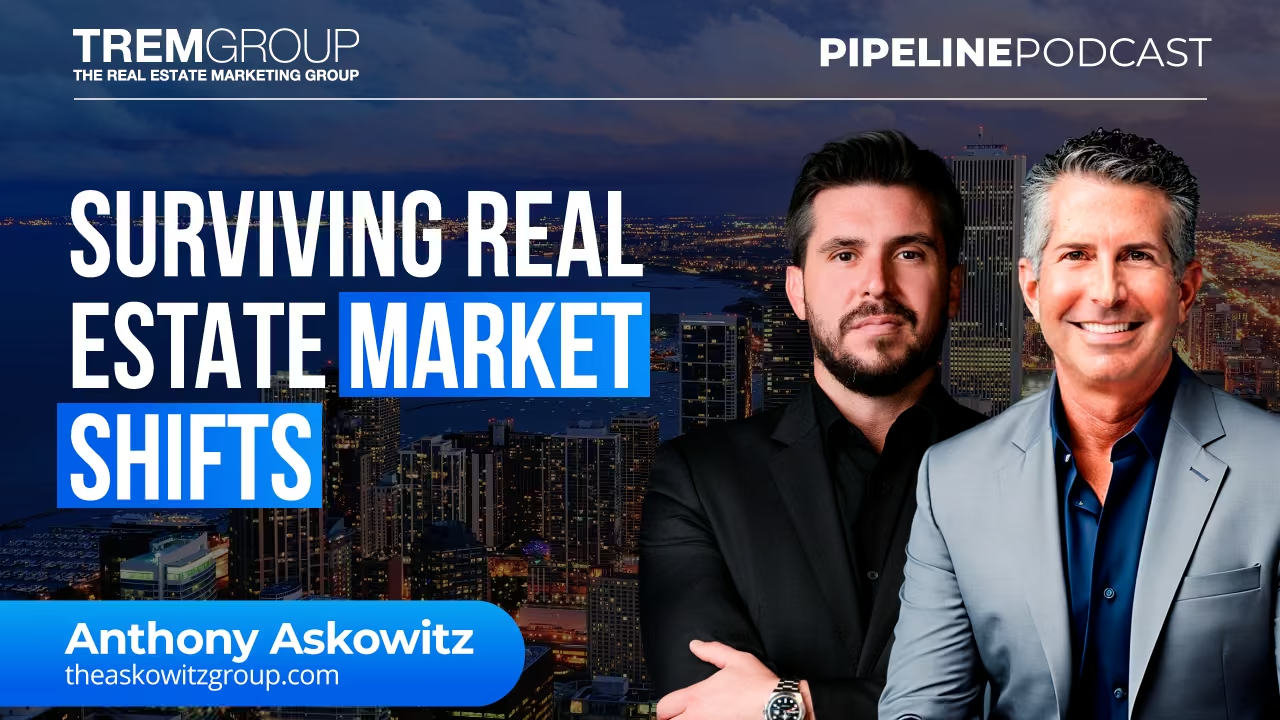
How do you survive 37 years in Miami real estate, close over 4.000 homes, and successfully navigate every market shift from the era of beepers to the rise of AI? In this episode of The Pipeline, Carlos Concepcion sits down with industry icon Anthony Askowitz (broke owner at RE/MAX Advanced Realty) to unpack the exact blueprint behind his multi decade career.
Together, they analyze the brutal reality of today’s market and reveal why top producers view technological shifts as business accelerators rather than threats. If you are stubborn about updating your workflow today, you are simply leaving money on the table for other agents to take.
Anthony also strips away the glamour of the industry to break down a profitable Miami real estate strategy, exposing the 5 critical listing mistakes agents make daily, from the smartphone photography trap to flawed pricing brackets that hide properties from active buyers. Whether you want to scale your team or secure your next deal, this conversation is your ultimate masterclass in market adaptability.
Video full transcription
Carlos: Welcome to another episode of The Pipeline. This podcast is dedicated to agents, brokers, developers in the industry. And our goal is to share what our partners and friends who have been in the industry and have built amazing businesses and provided a lot of value to their clients have done to build their pipelines to grow their business and ultimately provide value to their clients as well.
Carlos: And today I have a very special guest. His name is Anthony Askowitz. I’m very proud to be his partner and learn from him today. To give you a little bit of context, Anthony has been in the industry for 37 years, starting his real estate career. He’s been an authority in the Miami market. He has been consistently hitting his goals and helping his clients. He has helped over 4,000 families find or sell and buy their homes, has owned brokerages, sold brokerages, innovated into branding, marketing and have seen this industry change throughout the past almost four decades.
Anthony Askowitz: Yeah.
Carlos: So, it is my pleasure to have you here, Anthony. Thank you so much for joining us.
Anthony Askowitz: Thank you.
Carlos: And tell a little bit about yourself when you started on real estate. What was that like for you?
Anthony Askowitz: What was it like? Well, I was 23 years old. So, that was a long time ago, 10 years or so, but things were very different when I first got my real estate license.
In fact, I got my license and I said to my father, “Hey, Dad, I got my real estate license.” He says, “Oh, great. Are you going to do commercial real estate?” I said, “No, I think I’d rather do residential.” I said, “I think I want more transactions.”
I grew up with a gentleman who was very very good friends with my father who sold commercial real estate, but he would sell maybe one property every year, then he would have a bad year, and then he would have a great year. And I just didn’t see myself that way. I saw myself having transaction after transaction, just going, going, going.
I guess I could have done that maybe with commercials, but I saw residential as a different direction for myself. In fact, at that time in the office that I joined, it was predominantly female. A lot of those females were divorced or married to doctors or lawyers. It was a very different time.
In fact, I was known as Tony before I was Anthony. So, when I got to my first office, there was a gentleman by the name of Tony. So, I said, “Okay, I’ll switch to Anthony.” So, I became Anthony back in 1989. You can still call me Tony, but that was sort of the beginning. I was young. Immediately I was good at what I was doing. I worked seven days a week and in a very small window I became one of the top producers in that office of about 50 agents.
Carlos: So, we’re talking about 1989 and we’re now going into 1990. Yeah. Okay. So at that time the whole industry was different. We were talking about that a little bit ago. Um, what are things that you learned that first year that weren’t taught in school that you faced? What were the first challenges that you remember saying, “Oh, this has nothing to do with what they taught me when I did my license.”
Anthony Askowitz: Well, I will say it’s been so long since ago, but I will say this. In 1989, we did not have computers. We did not have an MLS that you can type in and have everything in front of you. We actually had books and the book would arrive every two weeks. It was a thick book with all the listings inside the book. So, if you had any clients, you had to immediately go to the book and look for properties. So, there was a delay if something sold.
The contract was basically one page with three pages underneath with this black film. I don’t remember what they call it, but you write on the top and it goes all the way through. So, you would rip out the contract page to hand it to your client. Things were very different. No cell phones. We had a beeper. Fax machines were just coming in and then within a few months we actually had our first what’s called a dot matrix or computer printer. So, which would go d-d-d. So we did have computers basically around 1990. The office had I think two or three.
Carlos: I mean we’re going to dive in deeper because you have so many stories to tell and education to provide. But you have seen the industry going from like you said no cell phones, beeper, no MLS, no internet, right?
No access to correct faster speed.
You were just mentioning you had to drive to get a contract signed. So it wasn’t the same level of access to be able to grow the business predictively at the time, but you are always innovative. You always have been well, first service first because I see you’re an amazing person and you give an amazing attention to detail to every conversation and to your clients and that’s what I mean I think that we all that knows you see that.
But that journey is right and I’m thinking hey what are those benchmarks or those dates in the last 37 years that you remember created a positive impact in your business in the industry can you tell us a little bit about those specific moments?
Anthony Askowitz: So I think back in ’89 ’90 you don’t know what’s coming. You don’t have any idea but you work with what you have and you can do only so much. If I can go back in time to that 23 year old and say, “Hey, do this.”
I think the things that I did back then to create my name brand, for example, and a person today can do it in a much shorter period of time with different exposure of course with the internet, social media. You can recreate what took me years of doing with billboards, TV, trucks, everything that I did can be recreated now. And for a new agent coming into the business, it’s a lot easier and different. They just have to do it, of course. If they don’t do it, it doesn’t matter what tools are available.
But with time, because I did have to drive and you have it was a different time period. You can maybe I sold 20 or 25 homes in that time period and the first year in business or and second, but today with the internet, with electronic signatures, with the ability to really be more in one place at the same time with marketing, you can I could be here where my business is still going and that’s something that we didn’t really have as the ability to back then.
I remember there was an agent in my office and she sold a house for $500,000. Okay, this is probably 1990. $500,000. She’s jumping up and down, running around like it was the biggest sale ever. And it was in 1990 to sell a $500,000 home. That’s like a $6-7 million home today. And it was just really exciting to see. But that energy and the times, you know, I see agents today that will shrug off a $100,000 $200,000 sale, but back in 1990 a $100,000 sale was a big time. It was really a lot.
And I believe that no matter what the sales price is of a home, condo, rental, it doesn’t matter. Those people deserve to have an agent who’s going to be attentive to them. So for me, I’ve always been about units. I’m not about volume. Would I take my car to Gables by the Sea? Oh, yes. I would be happy to. Or Cocoa Plum? No problem. But I think that if a consumer, a seller wants me, they’re going to get me. And it does not matter the price.
And remember too, those same people who are going to sell a $500,000 house today or $50,000 condo 37 years ago, they have friends, they have family, and those people will keep you in business for 37 years. And that’s what I learned. And the same person you sell a house to 30 something years ago, 15 years later, they call you to sell your house again, then they move and they call you again. And the amount of people that I’ve sold, bought and sold for the same family, the same couple multiple times. Unfortunately, sometimes it was at the beginning and now they’re heading off into a different lifestyle over 37 years. You meet them all and it’s really nice to see that progress and that circle of life type of thing that goes on.
But if you learn early on that referrals are the basis of your business basis and that relationship that you build with those clients, customers, friends will last you your entire career and I learned that early and that’s something that I would never change.
Carlos: We usually have this conversation often where again being in the industry you see that there are people looking at the seasonal transactions. There are seasonal agents, they’re looking at the money sign, they’re not thinking about building the relationship and servicing their clients the best they can, right? Nobody’s perfect, but as long as you’re doing the best you can, that client will trust you, will value your help and expertise and like you said they might become referrals for a lifetime, they’ll become partners for a lifetime. And I think that’s very important because we were talking about this earlier and I want your input on this because two things were highlighted right now while you were talking about. One is the importance of adapting to thrive. Okay. Because we don’t know where we’re going to be in five years with new technology arising or what the market is going to be like. But you just said it: in 1990 a $500,000 property, today 6-7 million, and you’re still providing a relationship and value driven to any of your clients.
Now, when you’re looking at the industry, when you’re looking at the percentages, you just mentioned statistics just minutes ago about agents and how many properties they sold or listed last year alone.
Anthony Askowitz: Yeah.
Carlos: And that’s impressive because that means exactly what we’re talking about. There’re people that are looking at it as a seasonal right, money driven, and there’re people that are building their business, believe in delivering and helping and consulting, which is what makes the difference between a professional and somebody that’s doing it as part-time or a hobby. So would you mind sharing some of those statistics? Because you know Miami is uh has what, 60,000 agents real estate professionals just in Miami.
Anthony Askowitz: Our association has 60,000 but we just merged and we are now at 93,000 and that’s the South Florida association basically. The difference is I think there was some stat I heard that 71% of all real estate agents did not have a transaction last year but there is what’s called the 80/20 rule: 20% of any person in a group of people salespeople do 80% of the business.
I think the 80/20 rule was very true 30 something years ago. I think today it’s more like 85/15 or even 90/10. I think that 10% of the real estate agents in Miami not only have a grasp on the real estate business, they have the clientele, the business, they’ve spent the time to learn, educate themselves, and that they are so much more valuable to their clients because they’ve taken the time to do it.
I think you were talking about short-term or shortsighted. I go on an appointment and I will say to the seller: “When I do a good job for you, which I will, can I expect two referrals from you?” If I ask them for it and they will say yes, they will give me at least two referrals. If you ask for it and you set expectations and you say “I will do this, this and this and we will have this incredible um experience…”
Carlos: Yes.
Anthony Askowitz: Result. The result will be you because it doesn’t come down to compensation. Compensation is what it is, but the compensation or the referrals is so much greater than that one sale of that one property. Um the relationship that you built.
So agents who are there come and go. “Oh, it’s so glamorous, so glamorous to be a real estate agent. It’s so I set my own hours.” You don’t set your own hours. You don’t. And if you do set your own hours, that means you’re not doing.
If a seller wants to sell their house, they call you. You show up at what time they’re available, if you could fit it in and move around. A buyer wants to see a property. Buyers don’t want to see a property when you’re available. It’s when they’re available. And you have to accommodate them. It’s after work. It’s on weekends. It’s so glamorous. It’s raining out there. It’s hot out there. Understanding what you’re there doing, it’s so much greater.
And the real estate business is ever evolving as you mentioned. Um what you know people say that, “Oh, the internet is going to wipe out real estate agents.” It didn’t. “AI is going to wipe out real estate agents.” It’s not. But there will be changes. There may be um less agents, which is perfectly fine.
We do not need 60,000 real estate agents in the Miami area. We don’t. That’s just a fact. But what we do need is experienced agents, agents who know what they’re doing and those who really have the best the consumers’ best interests at heart. And I think that makes a difference.
Carlos: I think that it’s exactly what you were referring to earlier on where the agents that adapt, that now understand that these tools that are coming up are just tools to help them be faster, better.
Anthony Askowitz: Yes.
Carlos: Uh, saving time while still providing value is what’s going to make the difference. And we were talking about something that I want to span on which is what you said it. It’s like today is easier for an agent to get all the branding within a week that may have taken me years, months to plan in the ’90s.
Anthony Askowitz: I think I could plug TREM right here. This is a good place for a good plug.
Carlos: Well, it’s a conversation, but…
Anthony Askowitz: But realistically, this is truly what can be done in months with you guys. What I’m able to do with you all is expand what I wouldn’t be able to do on my own. That’s truly what you guys do.
I mean, back in the day, I had been talking earlier. I was the first person in Miami to put my face on a real estate sign. Um, those signs rotted.
It was so early technology, but because of the humidity in Miami just rotted those signs. But to be the first to think of outside the box. I was actually at a real estate company for nine months, my first company. I actually left that company because they wanted me to think inside of a box and whatever they said went. That was it. There was no thought process. “This is how you do it.” And I questioned that. I questioned why can’t I have my face on a sign? Why can’t I? It was just a different mentality.
So, I did leave my first company after nine months and I’ve been with the same company now for 36 years since I left that first one. But this company that I’m with now, RE/MAX Advance Realty, allows me to think, allows me to be an entrepreneur. It allows me to think outside the box.
I had a truck: “Buy or sell with me, use my truck for free.” So people would buy or sell their home with me and they would use my real estate truck to move their home from one home to the other. And it and people would say, “Oh, I saw one of your trucks,” plural. I only had one, but that truck was all over the place. Uh it was being used.
So it was great advertising. But what happened over time, people stopped using the truck. People started using moving companies and just cost and to have a house in Miami, basically the truck became obsolete. But I used that truck for a good 20 some odd years, actually. I had ended up with three trucks over time: first one, second one, then the third one, but one at a time. So…
Carlos: Well, I think that people that have been in the industry for this long might remember the truck, they might remember the Askowitz TV commercials, your adaptation to you know the whole process. And now with us, our goal is to establish it digitally because you also have a broader reach now that you can get to everybody’s phones, devices, and be in front of the people that you want to work with.
Anthony Askowitz: Your reach is so great. Um uh and I was telling Stephen who’s over there, he’s our partner and we always give a shout out to him because he’s our chief marketing officer as in here in the studio. He’s amazing. So, I enjoy reaching out to him and texting him with that, “Hey, I just got a lead from you guys based on what you guys have produced.”
I got a call yesterday. It’s not 100% that it was from you all, but I think it is because it’s not something I did. Um and they found me um one because I was with RE/MAX and they were looking specifically for a RE/MAX agent, but they’re in Canada. So, how did they find me? It’s because of everything that you guys are doing. So, I think that reach would not have found that person. Um, and they’re going to be moving to Miami, buying a condo, million and a half to two million. I think that’s a good day. So, it’s that relocation. It’s getting that information out. And you can do it another way, too. You can take your properties and also expand the window of opportunity.
Carlos:There are a couple things that I see daily and I think that most agents are always expecting. I mean most agents that are not that do not understand what it takes to be at the highest level of the industry, they always want the quick fix, right? They’re like, “Okay, I want to be there quickly,” and they’re not looking at the long term. And it’s not one or the other. What you have done through 30 years and what we do is just compliments to be…
Anthony Askowitz: Sure.
Carlos: …you know, to have your online brand and online infrastructure findable, you know, displaying your brand. And I’m telling you this because that’s exactly, and we were talking about this right before we started recording, people want to be in that 1% without knowing what it takes. And you also put a great analogy because for those of you watching, Anthony was the number three tennis player in Florida uh and the 50s uh the 50-year category. And I would love for you to uh do that analogy for our viewers.
Anthony Askowitz: Okay. So, uh, a little over 10 years ago, I set a goal. My goal was to be in the top 10 tennis players in the state of Florida in the 50 and over division. So, I went to my coach. Um, yeah, I’ve been playing tennis at this point for 40 years, and I still have a coach. Um, I’ve had different coaches along the way, but to me, a coach will find things that in your game that may need a little tweaking or just someone who can help you with your business. There’s no difference.
Remember, real estate in my opinion and sports and tennis, all the same thing. You have to hone your skills.
So, I started working out heavier, playing more, watching what I was eating, and I started playing in tournaments, and I started winning. I was in shape. I was prepared. Um, and I was number three in the state before I knew it after winning a few tournaments. I never played number one and I never played number two. But by honing my skills and doing what it took to achieve, I was top 10 in the state of Florida. Uh, something that I’m very proud of.
I stopped there because I hit my goal. I am very goal oriented. And even in real estate too, I set a goal and I work to achieve it. Sometimes my goals are very lofty. And people will say, how are you going to achieve that goal? If I said to myself, I want to sell one house a month, 12. Okay, can I do that? Yes. But if I set a goal of selling two houses in a week, I’m going to achieve it. I’m going to push myself to do it. It’s seeing what is coming and preparing for it. I don’t just react today. It’s about what’s coming. I see the future and I want to be in the future. I want to be relevant in whatever I’m doing.
So, for those real estate agents out there, hone your skills. You need to be taking classes. A real estate coach is not the worst thing. Talking to your broker should be a really good coach and honing your skills and figuring out how to get from here to there. I mean, one of the biggest things that I find that real estate agents don’t have, they don’t even have a listing packet. They have no listing packet. They have nothing when they show up on a listing appointment.
Carlos: Let’s talk about that because before that, how many properties have you consistently been able to represent year-over-year?
Anthony Askowitz: Uh well, last year I had 121 transactions. So, um, this year I’ll be about 150. So, I’ll average about three transactions a week this year. I do have a team. So, it’s not just me by myself, but I do have a great team. I have support for everything. Um, the consumer seller, my sellers want me to be there for the showings, for the negotiations, for certain things that are important, but the seller doesn’t need me to be putting up a sign, ordering a sign, or making brochures. That’s not something that the seller is really wanting me to do. They want me to be there for what’s important. And I’m able to be there because I have a great support team behind me.
Carlos: So, I want to now talk about that because I do know how much your clients trust you and love working with you because you know you have them, you have their priorities in mind and you know you negotiate for them and you’re trying to get them the best deal possible. So, what are things that sellers today in Miami need to know when they want to sell their house? Why should they be aware of when working with a real estate professional? And what are the five mistakes that you see other listing agents do that might affect their clients?
Anthony Askowitz: Wow. Okay, that’s a two-part question.
Carlos: I’m sorry. We can repeat that.
Anthony Askowitz: We were going to take the second part first. We’re going to take the five mistakes that real estate agents that I see all the time. Uh the first mistake is the photos. Oh my goodness. Close the toilet seat.
Just do something or take the photos, not with your iPhone, though the photos are getting better. Use an app and clean up the room. I mean, there’s apps now that you can uh you can put in furniture. You can uh make the sky blue. Use it. I mean, if you take photos with your iPhone on a cloudy day, use an app and make it presentable.
I think that part of the marketing of an agent is to get that house ready for sale. And the first impression of those photos, horrible. And if you expect other real estate agents to uh show it, that’s a problem. Or and/or the consumer. With the photos.
The first eight photos have to tell everything about the house. So, having eight photos of the front of the house is no good. The front of the house is fine. If there’s a beautiful backyard, if it’s looking on a lake, uh the kitchen, certain things that are appealing, why did that seller buy the house? So, even the positioning and the order of the photos, really important.
Pricing strategy is also very important. So I’ll see a listing. I’ll give you two examples. Uh listing will be listed for $510,000. And I’ll say what are they thinking? Obviously this seller probably wants $500,000. Sounds like that’s what they would want to do. But what they’re missing is having a pricing strategy. The strategy is how does the consumer search for a home? They’re going to put if they’re searching on their own, same thing as a real estate agent. A real estate agent’s going to go in and type in a range. So, they’re going to type in 450 to 500,000. If they’re asking 510, they’re not being seen. They’re not in that range.
And if they’re going to go from 500, they’re going to go to to 550.
At 510, now you’re competing against a 550 home. So, having a strategy and understanding that, and it goes the same way, too. I used to price everything at 499,983 actually was my good luck number. But I got away with that because of this pricing strategy because up to 500,000 they would see it.
But if 500,000 was their bottom number at $499 it’s not seen. And along those same lines a seller sometimes they’ll price that same house let’s say at $495. That seller has given away $5,000 before they ever started. Negotiations give that $5,000. Price it at $500,000. The same buyer looks at it at 500,000 or 495. Same buyer. So there is a difference in real estate agents. There’s a difference in strategy, a different way of looking at things. Everything has to be done well thought out from start to finish. There’s no halfway. So I think there were three?
Carlos: Those are three. Now maybe some of the contracts uh issues that you see when selling a house. Um
Anthony Askowitz: So along the same lines, how long does it take to upload the seller’s disclosure? It should be there being prepared. Um all the information accuracy of what is inputed, garbage in garbage out accuracy. And I find so many mistakes um on other real estate agents uh input sheets of what they put in there.
So oftentimes a home may expire and I’ll look at the input sheet and this is wrong, this is wrong, this is wrong. I mean, for example, if the house is vacant, there’s no reason for a 24-hour notice on a vacant house. But if a real estate agent on Monday morning wants to show Monday afternoon and they see 24-hour notice, they’re not going to call because there’s not 24 hours for those who know what 24 hours means.
So, the point is to think about everything from start to finish, from A to Z. Everything has to be thought out. There’s no halfway, no partial. It has to be a system in place to make sure everything is correct.
Carlos: To that point, and just to reiterate because I think those are very important topics and it kind of translates to the build out of your brand and how you have you need to have a strategy for everything that you’re looking to do. I mean, pictures are crucial because the way it is today, you have to upload that listing into the MLS.
Anthony Askowitz: Yes.
Carlos: And then that listing gets distributed to every agent, broker sites, platforms out there, which is where consumers are today searching for…
Anthony Askowitz: Correct.
Carlos: …online. So if you don’t , if you don’t have that first impression high, they’re not not even going to click on the property to even try to schedule an appointment. So you lost the listing before you even posted it or showed it. Then the pricing structure, I agree with you. I mean, you have so much experience listing homes, and we’re going to talk about the markets and how you see the condition of this market now. But that was the second one. And the third you mentioned was the um 24-hour notice,
Anthony Askowitz: the information put in. Okay. Perfect.
Carlos: Now, if I’m a seller today…
Anthony Askowitz: Yes.
Carlos: …right. And you do all these five things.
Anthony Askowitz: I will. I will.
Carlos: Central point: if I’m a seller today and I want to list my house, how can you help me get it done sooner rather than later?
Anthony Askowitz: So the first question out of my mouth was, what are your goals, right? What are your goals? I will work with your goals. If your goal is to sell it quickly, then we have to have a strategy for it. If you have more time, we have a strategy for that. Everything is based on you. But then the question of expectations, what is expected? Uh, what does the consumer sell it for? What do they actually hear? So, it all goes together. You as an agent ask the question, what is your time frame? What are your goals? Why are you selling? Where are you moving to? Do you need help uh relocating to another area? I mean, finding an agent on the other end is something that we can also do. So, it’s having a strategy once again from start to finish.
Carlos: Listen first to consult later and then define the right strategy from A to Z to help that person.
Because there’s many different scenarios, especially in our market. There might be people that want to sell because maybe they’re they want to downsize, maybe they want to upgrade uh maybe they’re moving and relocating or buying a condo, divorce.
So there is every situation possible. So you analyze each case individually and then you present the best strategy and option for it.
Anthony Askowitz: But I will also explain the strategy. It’s not just, oh, do it this way, right? It explains why this is a strategy. So I think that part of my job is advisory. It’s also, you know, it’s uh this is why we do this. As I mentioned with the pricing strategy, how to explain why you price it this way. Why do we do what we do? It’s based on your needs and your wants and your desires and goals.
Carlos: So Anthony, let’s switch it a little bit to how you see the market behaving. Where do you see the market going? We already help you understand what it was like in 1990 price point wise, but how do you see the market behaving in Palmetto Bay, Cutler Bay, Kendall area, um Pinecrest, which are areas that you know very well, you help so many families in those markets. How do you see that market behaving right now?
Anthony Askowitz: I think they’re very stable areas. Um, in many ways I think that the consumer sellers happen to think that their houses are always worth more than they are. Um, uh, you know, I often ask before I go on that appointment, how much do you think selling your house is worth? I always ask because I kind of want to know what I’m up against or what I’m going to be dealing with. It’s so much more fun when they tell me a price and it’s actually worth more. That is so much fun. Um, but it’s when we’re right on uh the same, that’s easy. But when the sellers expect so much more for the house than what it is, that’s a problem.
And then as an agent, an agent has to make a decision either even to take that listing or not to take the listing. There’s a saying in real estate: it’s best to be the firstborn, second spouse, and third realtor. They all get the benefits.
So that third realtor, the first two fought with the seller about price and everything and then that third one just came right in and boom. I think it’s setting expectations and talking to that seller. Sometimes I choose to not be the first agent. Um if the seller’s expectations are not in line with the market, I’m not going to get referrals from them. They’re not going to be happy with me.
Um, in fact, they may even say something negative. Don’t want that. Um, my name is very valuable to me and the likeness and that I’m not the McDonald’s arches, you know, I don’t have to protect that, but I have to protect my name. It’s what I have. Um, so I think you have to make choices in your business. What is the most important thing with the seller? But it’s um expectations.
Carlos: Is so important that topic because you don’t have to get everybody’s business if it’s not the right business.
Anthony Askowitz: Correct.
Carlos: And I feel like people will appreciate more if they’re not the right person or you cannot help them that you tell them because once they go through spending them the time or the money or they go through the frustrations that you could have saved and advised against, they’re going to value your honesty in that initial consultation. They’re and again you’re saving yourself I mean protecting your values and what you believe in.
Anthony Askowitz: Sure.
Carlos: By not um taking that listing or taking that business if it’s not aligned with the market, the expectations or the goals of that giving client.
Anthony Askowitz: Having a sign on a property for 6 months, eight months, no, the neighbors see it also.
Carlos: And usually that happens because all those five steps weren’t met, the expectations weren’t consulted correctly, and then there wasn’t the right strategy in place.
Anthony Askowitz: A seller who’s motivated or has a reason to to sell is a seller who will do the best if they price it correctly at the beginning. They’re going to be so much better off than by chasing the market down if that’s what they end up doing.
Carlos: Anthony, part of the purpose of this podcast, too, is to kind of bring light to agents who want to, if they’re starting, build a career out of real estate or if they’re already in the industry, how can they elevate and predictably grow their business? Okay, you’ve been innovating, investing in yourself, in your name, in your brand for over 36 years, 37 years. So I want your feedback and I want your opinion for them on how they can do it today. I mean besides everything else that I told you, being value driven and service driven first, but how can they succeed? Because like you said, in order to stay in the game for longer, you have to adapt. You have to thrive. You have to learn. You have to continue to improve. Hone in your skills and provide value to your clients through the five strategies. But if I’m a new agent, if I’ve been in the business and I’m no longer looking for a quick solution, I’m looking at the long term, what are things that you recommend to help them in their business?
Anthony Askowitz: Okay. Well, this may be a little controversial for some of the things I’m going to say, but I’m going to say it. Uh, first thing is do what is best for the consumer, not what is best for you. That’s numero uno.
Agents choose companies that they perceive is better for them if it splits or whatever it is. But the consumer, the seller, the seller has a choice. The seller has a choice. They can buy a watch. They could buy a Rolex or a Swatch watch. They both tell time. Which one does the seller want?
Carlos: The one he wants.
Anthony Askowitz: Huh?
Carlos: Do they want the Rolex or the Swatch? Swatch watch. Do you know what a Swatch watch is?
Anthony Askowitz: Yes. Yes. Okay.
Carlos: I like the watch and I like the Rolex. So…
Anthony Askowitz: Well, which one would you rather have?
Carlos: Both.
Anthony Askowitz: No, no, no. You can only have one.
Carlos: I like the Rolex. Okay. Has the brand trust. I like history.
Anthony Askowitz: Tells all the time. But yes, that is what the consumer wants. Just what you said, the Rolex. Are you wearing a Rolex right now?
Carlos: Actually, right now, yes, I am.
Anthony Askowitz: Oh, look at that. Okay.
Carlos: Cartier had to say.
Anthony Askowitz: Yes. Yes. So, you chose to wear a Rolex instead of a swatch. The consumer seller can choose a Rolex or a Swatch. They both can sell real estate. They both tell time. But what does that consumer want? They would want a Ferrari. They want the name brand to go with it. And a lot of the agents out there don’t have a name brand yet. So you should rely on your companies.
I’ve been at the same company for 36 years and the company I was with before had a name brand also. The company I’m with, RE/MAX, is in 120 countries throughout the world.
Do you think I don’t use that on a listing appointment? That everyone knows our name, that people will have no problem putting 50 $100,000 into our escrow account because we’re RE/MAX because they know it?
That if they go to any foreign country, they see it everywhere.
Understanding the consumer, doing what the consumer wants, what’s best for them. So, I think that’s the first thing.
Second thing is being in an office that is conducive to growth, that has a uh the yellow brick road of how to get to Oz, how to get to that goals. I think it makes a difference. Um I a lot of people are brokers who are good teachers, but they may not be good coaches.
Carlos: Coaches or or or or producers.
Anthony Askowitz: I find that um to me having someone who produces or people surrounding myself with people who produce is a benefit to me, being around like-minded people. I’ll give you another analogy. Sports.
We like sports. So, if you play uh basketball with my three daughters, you’re going to play at a certain level, though they’re very good. Okay? But if you play basketball with the Miami Heat, you’re going to play at a higher level.
So, agents will choose an office because it’s around the corner or their best friend sent them there or whatever. There’s a saying about you surrounding yourself, your five best friends are your…
Carlos: …determine your future.
Anthony Askowitz: So, if you surround yourself with people who produce more than you, you’re going to push you. And the amount of agents that I find that choose to go to a small boutique office, which sounds nice, but the sellers aren’t calling them to uh they’re not competing on interviews uh for listing appointments. The big boys are.
The opportunities, extras, all these intangibles that you get with being with a uh name brand company. And there’s other name brand companies out there other than RE/MAX, but RE/MAX for me has been the best place that I can ever imagine for me. I think for those who want to produce and achieve.
The average RE/MAX agent for example, this is not a commercial for RE/MAX but it is I guess uh out sells everyone else two to one. This nationally a RE/MAX agent sells two times more than any other company.
You surround yourself with higher quality, the intangibles, referrals that come in. There’s so many benefits of being with and I think once again agents are short-sighted that they will choose an office for the 110% split. And 100% there’s nothing. 100% of nothing is not as good as 50% of something. And when I first started in the business I’m going to tell you I was at a 47 and a half percent split. Meaning I got 47 and a half and my company got the rest. That’s what it was back then. Granted, the structure has changed a lot now in those 30 plus years, but what hasn’t changed to me is the consumer wanting the Rolex. Um, and going in there prepared and knowing what you have to offer. I think it’s a big difference.
Education. There are a lot of education opportunities out there that people are not taking the chance to learn. I mean, they should know what the contract looks like backwards and forwards, the sales contract, the listing contract, know about homestead exemption, portability, know about basic laws that are available to them.
And I think by not knowing these things put them at a disadvantage. And every listing for every agent out there has a huge value. What is the value if the value of a listing is let’s say $15,000? Let’s use that as a number. What would you do for $15,000? What would you do if you went streaking down the street naked for $15,000? What are you willing to do?
So the idea is to concentrate on your business. Work your business. Don’t be watching The Bachelor or The Bachelorette. Do your business. Uh work your business.
That 23 year old understood that he could give up his weekends and work seven days a week for the future. He understood that. He understood certain things. If you get your sphere of influence, put it together now. You do your database, get it all ready that you don’t have to do in 10 years, 5 years, you just add to it. Setting up your systems today, those nuts and bolts today helps you down the road. It’s all about what you want to achieve. And I think it all goes together.
Carlos: I like that a lot because I mean, even from different backgrounds nowadays, you have so much smoke and mirrors out there.
Anthony Askowitz: Oh, yes.
Carlos: Right. You have so many gurus telling you how you can be a millionaire overnight and how you don’t need to spend time or sacrifice to succeed. But uh my partner uh Stephen and we always talk about this is like overnight success sometimes takes 10 years or 20. And you have to sharpen the axe. You have to be better.
You have to educate yourself and dedicate yourself if you want to be better and build something that lasts. And I think that’s a fantastic point that you know that you’re giving to everybody that’s watching and to me because I look up to you and I appreciate you being here today. And I think you’re wearing the dot with everything that you said.
And it applies not only to the real estate industry. It applies to everybody and to everything that you’re willing to do and sacrifice for them from the 23 year old to the almost under 60. That’s how you get to your goals.
That’s how you say your goals. You make a plan, you make a strategy and you work hard for it, right? And then you choose the right systems, you shoot the right the right partners and that allows them to grow.
So I do value you a lot. I appreciate you so much for being here today with me and sharing this space. I hope that everybody on the other side of the camera on the other side of this channel enjoys it too.
And if any of you are looking to contact uh Anthony, you can go to askowitz.com. Yeah. Or how can they find you online?
Anthony Askowitz: Well, you could follow me at Anthony Askowitz um on Instagram, Facebook, um and you’re welcome to call me at any time at 305-879-7979.
Carlos: There you have it.
Anthony Askowitz: You can text me if you have questions or I have nothing uh but wanting to help out there.
Carlos: Anthony has so much knowledge that I really hope that you join us again.
Anthony Askowitz: Oh, sure.
Carlos: We have another conversation to provide more information because I mean you’re it’s amazing to have you here.
Anthony Askowitz: Anytime.
Carlos: So we have a little thing, a couple more things to do. So for now for The Pipeline, we’ll see you on the other side. Thank you so much for being here.
Anthony Askowitz: Pleasure. Thank you.