Most real estate agents spend money on advertising. Fewer get a return worth talking about. The difference usually comes down to strategy, not budget.
Agents who build campaigns around a clear audience, a specific goal, and consistent measurement tend to outperform those who simply boost posts and hope for the best.
The advertising options available to real estate professionals in 2026 are broader than ever. Google, Meta, YouTube, LinkedIn, programmatic display, local service ads, and even connected TV all compete for your attention and your dollars.
That can feel overwhelming, but it also means there is a channel for almost every type of property, market, and price point.
This guide covers the strategies that are producing real results for agents and brokerages right now.
We will walk through each major platform, show you how to allocate your budget based on your goals, share the benchmarks you should be measuring against, and highlight the mistakes that waste the most money.
Why Most Real Estate Ads Underperform
Before getting into tactics, it is worth understanding why so many real estate advertising campaigns fall flat.
The pattern is predictable: an agent runs a few Facebook ads, gets some clicks but no closings, decides that paid advertising does not work, and goes back to relying on referrals and open houses.
The problem is rarely the platform itself. It is usually one of three things.
- First, the targeting is too broad or too narrow. An ad for luxury condos in Brickell shown to everyone in Miami between the ages of 25 and 65 is going to waste most of its budget on people who will never buy a $2 million condo.
- Second, the landing page does not match the ad. An ad promising a free home valuation that sends traffic to a generic homepage creates friction and kills conversions. Instead, you need high-converting landing pages.
- Third, there is no follow-up system. A lead that fills out a form and gets a call three days later is already cold.
Getting these three fundamentals right will do more for your ad performance than any clever creative or targeting hack. Build your campaigns on this foundation and the platform-specific strategies below will work much harder for you.
Google Ads for Real Estate: Search, Display, and Local Service Ads
Google Search Ads
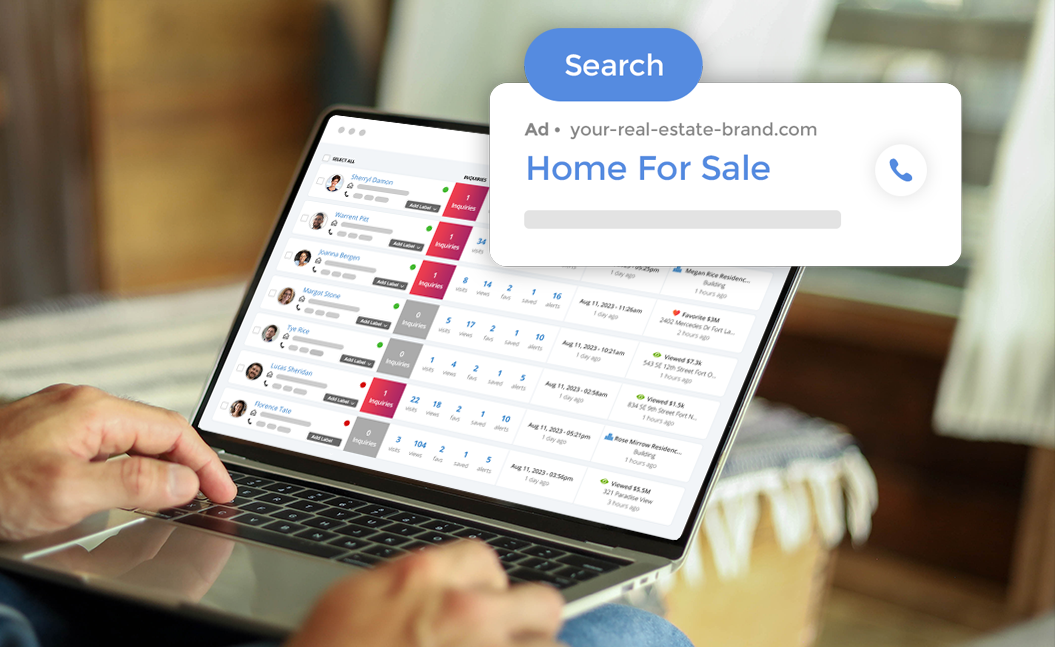
Google Search remains the highest-intent advertising channel for real estate. When someone types “homes for sale in Scottsdale” or “best realtor in Austin,” they are actively looking. That intent makes search ads one of the most reliable ways to generate qualified leads.
The key to profitable real estate search campaigns is keyword specificity. Broad keywords like “real estate agent” cost a lot and convert poorly because the intent is scattered.
Someone searching that phrase might be looking for licensing requirements, salary data, or how to become an agent.
Long-tail keywords like “luxury home buyer agent Palm Beach” or “sell my condo downtown Miami” carry much clearer intent and typically cost less per click.
Ranking for these search terms is exactly what we specialize in through our search engine marketing services.
Negative keywords are just as important as the ones you bid on. Add terms like “salary,” “license,” “free,” “jobs,” and “how to become” to prevent your budget from leaking into irrelevant searches.
Review your search terms report monthly.
For landing pages, create dedicated pages for each campaign theme rather than sending all traffic to your homepage.
A search ad about selling luxury homes should land on a page about your listing services, track record with luxury properties, and a clear call to action for a consultation or home valuation.
Google Local Service Ads
Google Local Service Ads (LSAs) sit above traditional search ads and carry a Google Screened badge.
For real estate agents, this placement is extremely valuable because it combines high visibility with built-in trust signals.
LSAs operate on a pay-per-lead model rather than pay-per-click, which means you only pay when someone actually contacts you through the ad.
The cost per lead varies by market, but agents in most US metros report spending between $20 and $60 per lead through LSAs, which is competitive with or better than traditional search ads.
The qualification process for Google Screened involves a background check and license verification, which keeps the competition lower than standard search ads.
If you have not set up LSAs yet, this should be one of your first moves. The setup process takes a few weeks due to the verification steps, so start early.
Google Display and YouTube
Display and YouTube ads serve a different purpose than search. They are awareness and retargeting channels, not direct lead generation tools.
Expecting a display ad to generate the same cost-per-lead as a search ad is a recipe for disappointment.
Where display and YouTube shine is in retargeting. Someone who visited your website, viewed a listing, or watched one of your property tour videos can be shown follow-up ads across the Google Display Network and YouTube for a fraction of the cost of acquiring a new visitor.
Retargeting campaigns typically see 2x to 5x better conversion rates than cold campaigns because the audience already knows who you are.
For YouTube specifically, short-form ads (6 to 15 seconds) work well for brand awareness, while longer property walkthrough videos (2 to 5 minutes) perform better as organic content that you then promote to targeted audiences.
Facebook and Instagram Advertising for Real Estate
Campaign Structure That Works
Meta’s advertising platform (covering both Facebook and Instagram) remains the most popular channel for real estate agents, and for good reason. The targeting options, creative formats, and cost structure make it accessible for agents at every budget level.
The most effective campaign structure for real estate on Meta follows a three-tier approach.
At the top, you run awareness campaigns showing property highlights, market updates, or neighborhood spotlights to a broad local audience.
In the middle, you target people who have engaged with your content, visited your website, or match your buyer or seller profile with more specific offers like a free home valuation or a buyer consultation.
At the bottom, you retarget warm leads who have taken an action but have not yet converted, using testimonials, case studies, or urgency-based messaging.
This funnel approach costs more to set up initially, but it produces better leads at a lower cost over time compared to running a single campaign aimed at cold audiences.
Creative Formats That Convert
Carousel ads showing multiple rooms or properties consistently outperform single-image ads for real estate.
They give potential buyers a reason to swipe and engage, which signals to Meta’s algorithm that the ad is interesting and worth showing to more people.
Video ads perform even better, particularly short property tours (30 to 60 seconds), agent introduction videos, and market update reels.
The production quality does not need to be Hollywood-level. In fact, many agents find that authentic, phone-recorded walkthroughs outperform polished productions because they feel more genuine and less like a traditional advertisement.
Lead form ads (where the user fills out a form without leaving Facebook) generate the highest volume of leads, but the quality is typically lower than traffic ads that send people to a landing page.
A good compromise is to use lead forms with qualifying questions. Adding a question like “Are you pre-approved for a mortgage?” or “When are you looking to buy?” filters out casual browsers and improves lead quality significantly.
Budgets and Benchmarks
For a single agent starting out with Meta ads, a monthly budget of $500 to $1,500 is enough to test and learn.
Agents and teams spending $3,000 to $10,000 per month can run the full funnel approach described above.
At the team or brokerage level, budgets of $10,000 to $50,000+ per month are common, particularly for new development marketing.
Benchmarks to measure against: a cost per lead (CPL) between $5 and $30 is normal for real estate on Meta, depending on your market and how qualified the leads are.
Cost per closed deal is the number that actually matters, and top-performing agents report spending between $500 and $2,000 in ad spend per closed transaction. If you are above $3,000 per closed deal and your average commission is under $10,000, the math stops working and you need to revisit your strategy.
LinkedIn Advertising for Commercial and Luxury Real Estate
LinkedIn is often overlooked by real estate agents, but it is one of the best platforms for reaching high-net-worth buyers, commercial investors, and developer prospects.
The targeting options based on job title, company size, industry, and seniority make it possible to put your message in front of exactly the right people.
The cost per click on LinkedIn is higher than Meta (typically $5 to $15 versus $1 to $3), but the lead quality for luxury and commercial real estate tends to be substantially better.
A $50 CPL on LinkedIn that brings in a serious investor is worth far more than a $5 CPL on Facebook that brings in someone who was just curious about listing prices.
The content that performs best on LinkedIn is educational rather than promotional. Market analysis posts, investment return breakdowns, and thought leadership articles generate more engagement and leads than listing photos.
Sponsored content that links to a detailed market report or investment guide, gated behind a contact form, is one of the most reliable LinkedIn strategies for commercial real estate professionals.
Budget Allocation: Where to Put Your Money
How you split your budget across channels depends on your niche, your market, and your goals. There is no single formula that works for everyone, but there are patterns that work for most agents.
For residential agents focused on buyers: allocate roughly 40% to Meta (Facebook and Instagram), 30% to Google Search and LSAs, 15% to retargeting across all platforms, and 15% to testing new channels like YouTube or programmatic display.
For residential agents focused on listings: shift more budget toward Google Search (40%) since seller intent keywords convert well, keep 30% on Meta for sphere-of-influence marketing and just-sold campaigns, and use the remaining 30% for retargeting and direct mail integration.
For luxury and commercial agents: LinkedIn deserves 25% to 35% of the budget. Google Search stays important at 30%. Meta takes a smaller share (20%) focused on aspirational lifestyle content and retargeting. The remainder goes to programmatic display on premium publisher sites and connected TV.
For developers marketing new construction projects: the budget is typically larger and more front-loaded.
- Pre-launch phases lean heavily on Meta and Google Display for awareness.
- Launch phases shift to Google Search and LSAs to capture active buyers.
- Sell-through phases focus on retargeting and price-reduction campaigns.
TREMGroup’s developer clients have found that a phased approach like this, with budgets adjusted monthly based on absorption rates, consistently outperforms static campaigns that run the same ads for months at a time.
Measuring What Matters: ROAS and Attribution
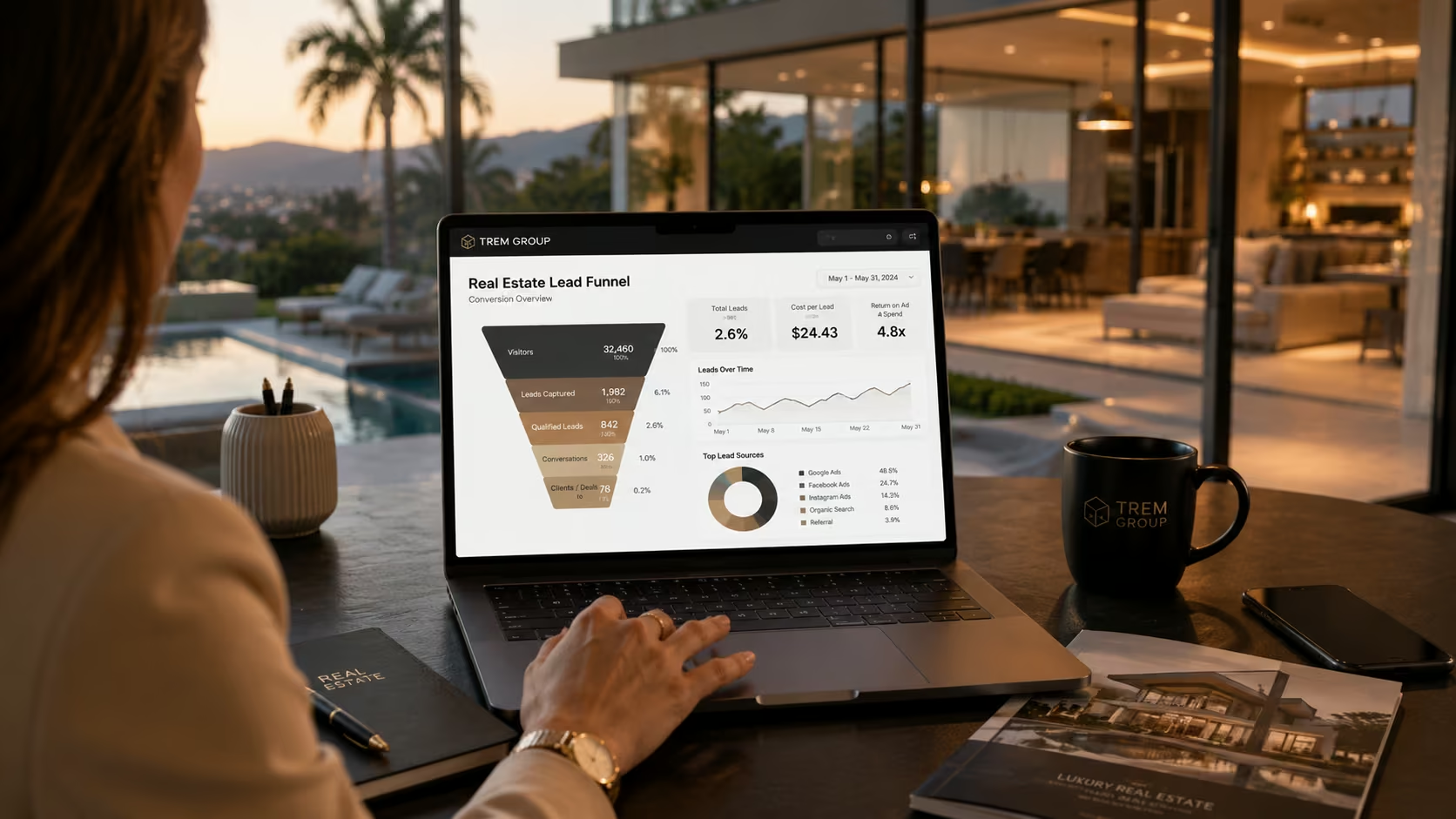
The most dangerous metric in real estate advertising is the cost per lead. It is dangerous because it is easy to measure and easy to game. You can get $3 leads all day on Facebook if you do not care about quality.
The agents who run profitable ad campaigns focus on two numbers instead: cost per qualified appointment and cost per closed transaction.
Setting up proper attribution requires a few things.
- First, you need conversion tracking on your website through Google Analytics and the Meta pixel.
- Second, you need a CRM integration that tracks lead source all the way through to closing. If you don’t know how to set up this tracking, our digital brand management team can handle the infrastructure for you.
- Third, you need discipline about recording where every deal originated, even when the attribution is messy (and it often is).
ROAS benchmarks for real estate advertising vary widely by market and price point. As a general target, agents should aim for at least 5x return on ad spend when measured over a 6 to 12 month period.
That means for every $1,000 spent on advertising, you should generate at least $5,000 in gross commission income from the leads those ads produced. Agents in luxury markets often see 10x to 20x ROAS because the commission per transaction is so much higher, even though the cost per lead is also higher.
If you are not tracking these numbers, you are guessing. And guessing with an advertising budget is an expensive habit.
Common Mistakes and How to Avoid Them
After managing over $450 million in advertising spend across real estate campaigns, a few mistakes come up again and again. Avoiding these will put you ahead of most agents in your market.
- Running the same creative for too long. Ad fatigue is real. On Meta, refresh your creatives every 6 to 8 weeks. On Google, test new ad copy quarterly.The drop in performance is gradual, so many agents do not notice until their cost per lead has doubled.
- Ignoring mobile experience. Over 70% of real estate ad clicks come from mobile devices. If your landing page loads slowly, is hard to navigate on a phone, or has a contact form with 15 fields, you are losing most of the traffic you paid for.
- Not following up fast enough. The window for connecting with an online lead is measured in minutes, not hours. Agents who respond within 5 minutes convert leads at 8x the rate of those who wait an hour. If you cannot respond that quickly yourself, set up automated text and email sequences that engage the lead immediately while you get back to them.
- Stopping too early. Real estate advertising compounds over time. Your pixel data improves, your retargeting audiences grow, your creative library expands, and your cost per lead drops.
Agents who run campaigns for 3 months and quit because they did not see immediate results miss the compounding effect that typically kicks in around months 4 to 6.
Putting It All Together
Effective real estate advertising in 2026 is not about being on every platform or having the biggest budget. It is about matching the right message to the right audience on the right channel, and then measuring what actually produces revenue.
Start with one or two channels where your target audience spends time. Build campaigns with proper targeting, dedicated landing pages, and fast follow-up systems.
Measure cost per closed deal, not just cost per lead. Reinvest in what works and cut what does not. And give your campaigns enough time to mature before judging their performance.
If you want help building or auditing your real estate advertising strategy, TREM Group’s marketing team has managed campaigns across every major platform for agents, teams, and developers.
Whether you are spending $1,000 a month or $100,000, we can help you get more from every dollar.
Investing Money in Marketing With No Results?
Real estate professionals like you turn to us when their marketing isn’t working. Stop wasting your budget on strategies that don’t deliver. Let’s create a marketing plan that drives real growth and success for your business.