
Somewhere right now an agent in Miami is on the phone with a past client who just accepted a job in Denver.
The agent cannot work the Denver deal, but the relationship is worth real money. One referral agreement later, a Denver agent gets a warm, motivated buyer, the client gets a vetted local expert, and the Miami agent collects a check at closing for making one introduction.
That is the referral economy, and it moves a meaningful share of all residential transactions in the United States.
Done right, referral fees are one of the cleanest revenue streams in real estate. Done wrong, they violate federal law, state license law, or both.
This guide covers what referral fees actually run in 2026, the rules that apply in every state, where state law differs, what belongs in the agreement, and how the income gets taxed. One caveat up front: this is general information, not legal advice.
License law lives at the state level and changes, so confirm specifics with your broker and your state real estate commission before money moves.
What a Referral Fee Is (and What It Isn’t)
A real estate referral fee is compensation one licensed broker pays another for introducing a client who closes a transaction.
The referring agent hands over the relationship, the receiving agent does the work, and the fee comes out of the receiving side’s commission at closing.
Notice what that definition excludes. A thank-you payment to your unlicensed cousin for mentioning your name is not a referral fee, and in most states paying it is illegal.
A kickback from a title company for steering business is not a referral fee either; that one violates federal law. The legitimate version has three marks: both sides hold licenses, the payment runs from broker to broker, and it is documented in writing before closing.
The Going Rate: What Referral Fees Actually Run
The industry standard is 25% of the gross commission on the referred side of the transaction. That number is convention, not law.
No state statute sets a referral percentage, so everything is negotiable, but 25% is the figure most agents quote and most agreements use.
The realistic range runs from 20% to 35%. Simple name-passing sits at the low end. A referral that arrives pre-qualified, motivated, and ready to transact justifies more. Fees climb toward 30% or 35% when the referring agent stays involved, or when the client is high value and both sides know it.
Relocation companies are the exception that proves the negotiability point. Corporate relocation firms routinely take 35% to 40% of the commission for the business they control, and agents accept it because relocation volume is steady and the clients are transferees who have to move.
Here is the math on a typical deal. A referred buyer purchases at $600,000 with a 2.5% commission on the buy side, which is $15,000 gross. A 25% referral fee sends $3,750 to the referring broker.
The receiving agent’s remaining $11,250 then goes through their own brokerage split. Run that math before you negotiate, because a 35% fee on a small deal can leave the receiving agent working for very little.
The One Rule That Applies Everywhere: Broker to Broker
Whatever state you practice in, one rule holds: referral fees flow between brokers, not between agents. Your license hangs under a broker, and license law in every state says compensation for brokerage activity passes through that broker.
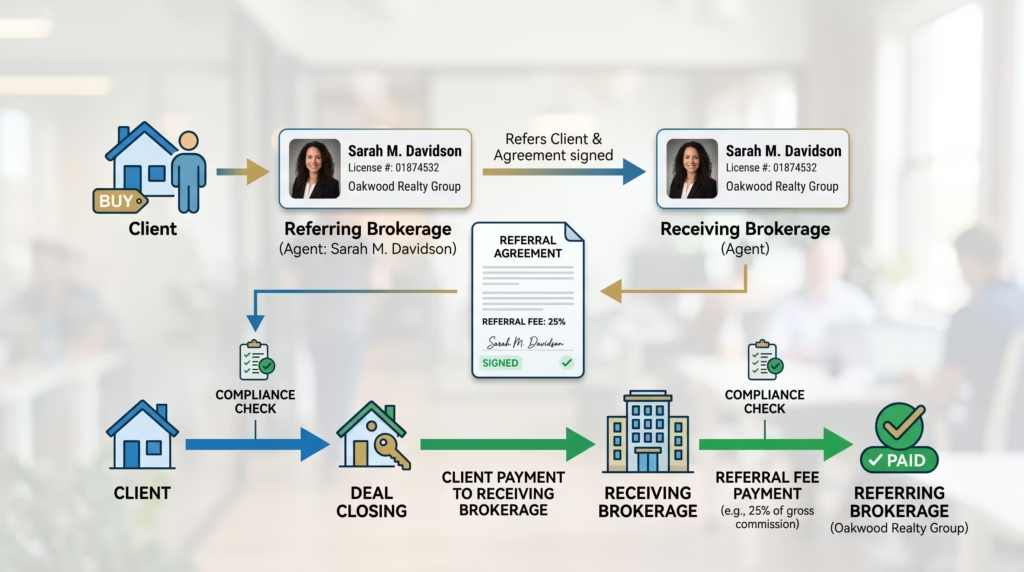
In practice the flow looks like this.
- The receiving agent closes the deal and their brokerage collects the commission.
- The receiving brokerage pays the agreed referral fee to the referring brokerage.
- The referring brokerage then pays its agent according to their split agreement.
An agent who accepts a referral check written directly to them personally has just handed their state commission an easy violation.
The same principle covers the other direction. You cannot pay a referral fee to an unlicensed person for sending you business.
Most states flatly prohibit compensating unlicensed individuals for referrals, though many allow token thank-you gifts of modest value that are not tied to a closed deal. Where exactly the gift line sits varies by state, which is one more thing to confirm locally.
The Federal Layer: Where RESPA Draws the Line

The Real Estate Settlement Procedures Act is the federal law that polices referral money around home purchases, and Section 8 is the part that matters.
It prohibits giving or accepting anything of value in exchange for referring to settlement service business connected to a federally related mortgage.
Settlement services means the whole closing supply chain: lenders, title companies, escrow, appraisers, inspectors, insurance.
The good news for agents: RESPA contains an exception for cooperative brokerage arrangements, which is exactly what an agent-to-agent referral is. Licensed broker to licensed broker, tied to real brokerage work, is the lane Congress left open.
The trouble starts when the money crosses industry lines. A lender paying you for steering borrowers, a title company covering your marketing costs in exchange for closings, free leads from a settlement provider with strings attached: all of that sits squarely in Section 8 territory, and penalties reach $10,000 in fines and a year in prison per violation, plus liability of three times the charge in private suits.
The simple test: if the payment comes from anyone other than another real estate brokerage, and business referrals are part of the deal, stop and get compliance advice.
State by State: How the Rules Break Down
Here is the honest truth the listicles skip: no state caps referral percentages by statute, and the broker-to-broker rule applies in all fifty.
What actually varies by state falls into four buckets. Rather than reprint fifty statutes that change every legislative session, this section shows you the four questions to ask about your state, and the receiving state, on every referral.
1. Who can receive a fee
Every state requires an active license to receive brokerage compensation, including referral fees. The wrinkles involve inactive and referral-status licenses. A number of states let agents park a license in inactive or referral-only status and still collect referral fees through a broker, which is how referral-only brokerages exist. These firms hold licenses for agents who left active practice and live entirely on referral income. Other states restrict what an inactive licensee can be paid for, or when, based on their status at the time of the referral. If you are winding down active practice but want to keep monetizing your sphere, this is the specific question to put to your state commission.
2. Out-of-state referrals
The cross-border referral is the classic case, and it works almost everywhere, with a catch. You do not need a Colorado license to refer your client to a Denver agent and collect a fee through your brokers. What you cannot do is perform licensed activity in a state where you hold no license: no showing property, no negotiating on the client’s behalf, no advising on offers in the destination market. Make the introduction, paper the agreement, and step back. Several states also have specific statutory language about paying fees to out-of-state brokers, which the receiving brokerage will know how to handle.
3. Rebates to the client
Sometimes the referral discussion is really a rebate discussion: can an agent share commission with the buyer or seller themselves? Most states say yes, and the Department of Justice has actively encouraged rebating as price competition. Roughly ten states still ban or restrict consumer rebates, so an agent offering a closing credit needs to check which camp their state falls in. Rebates to your own client are generally exempt from RESPA trouble, since the payment is a price reduction rather than a referral kickback.
4. Gifts to unlicensed people
The last bucket covers the past client who keeps sending you business. States draw this line differently. Some permit small gifts of appreciation with dollar caps, some require the gift to be unconditional and disconnected from any specific transaction, and a few are strict enough that a gift card for a closed referral is a violation. The safe pattern everywhere: keep gifts modest, never promise them in advance, and never tie them to a deal closing.
The Referral Agreement: Get It in Writing
A referral without a signed agreement is a favor, not a fee. Courts and arbitration panels see these disputes constantly, and the agent with the signature almost always wins.
Paper the agreement before you hand over the client’s contact information, because your negotiating position evaporates the moment the introduction is made.
A solid referral agreement fits on two pages and covers seven points:
- The parties: both brokerages by name and license number, plus the referring and receiving agents.
- The client: who is being referred, and for what need. Buying, selling, or both.
- The fee: the percentage of gross commission on the referred side, stated plainly, with an example if you want zero ambiguity.
- The scope: one transaction, or every transaction the client closes with the receiving agent within a defined window.
- This is the clause agents forget. If your referred buyer also lists their current home with the receiving agent, a one-transaction agreement leaves that commission on the table.
- The term: an expiration date, commonly 12 to 24 months, after which the obligation ends.
- Payment timing: due at closing, paid from escrow or within a set number of days after the receiving brokerage collects its commission.
- Signatures: both brokers, not just the agents, since brokers are the ones legally exchanging the money.
State and local Realtor associations publish standard referral agreement forms, and most brokerages keep a house version. Use one of those rather than drafting from scratch.
Taxes: How Referral Income Gets Reported
Referral fees are ordinary self-employment income, taxed the same as your commission checks.
The receiving brokerage reports what it paid your brokerage, your brokerage reports what it paid you, and your share lands on the 1099 your brokerage issues you at year end.
One threshold changed for 2026, and it is worth knowing.
Under the 2025 federal tax law, the reporting threshold for 1099-NEC and 1099-MISC forms rises from $600 to $2,000 for payments made after December 31, 2025, with inflation adjustments starting in 2027.
So a single $1,500 referral fee paid in 2026 may not generate a form at all. Do not mistake that for tax-free income.
The reporting threshold changed; the taxability did not.
Every referral dollar is reportable income whether or not a form arrives, and state filing thresholds do not all match the federal number.
Keep your own records and hand your accountant the full picture.
Ethics and Disclosure
For Realtors, the Code of Ethics adds a disclosure layer on top of the legal rules. Members must disclose their status as agents when seeking compensation and keep clients informed about who is being paid what.
The cleaner practice, member or not, is to tell the client a referral fee exists. It costs the client nothing, since the fee comes out of the receiving agent’s commission, and clients who later discover an undisclosed fee tend to feel sold rather than served.
One sentence handles it: the agent I am connecting you with will pay my brokerage a referral fee out of their commission, at no cost to you.
The other ethical trap is referring purely to the highest bidder. Your name rides on the referral. Send your client to the agent who will serve them best among those willing to pay a standard fee, not to whoever offered 40%.
One botched referral costs you the client, the review, and every future deal in that relationship.
When Referring Beats Keeping the Client
Agents lose money in both directions on this decision. Some refer away business they should keep. More often, they keep business they should refer: the deal two hours away, the property type they have never sold, the price band where they have no comps knowledge.
Working a transaction badly outside your lane earns less per hour than your core business, exposes you to liability, and produces a mediocre client experience that kills repeat business.
The clean decision rule: refer when the deal sits outside your geography, outside your property expertise, or outside the time you can actually commit.
A guaranteed 25% of a well-served transaction beats 100% of a deal you fumble, and it costs you roughly an hour of work.
Platform Referrals: The New Middlemen

A growing slice of referral volume now flows through platforms rather than agent relationships.
Zillow’s Flex program, realtor.com’s ReadyConnect, OpJa, and a long list of similar services operate as licensed referral brokerages: they hold broker licenses, send you consumer connections, and take a success fee at closing instead of charging upfront for leads.
The percentages run rich. Platform referral fees commonly land between 30% and 40% of the commission, well above the agent-to-agent standard, and the platforms can charge it because they control high-intent consumer demand at scale.
Whether that trade makes sense depends on your alternatives. An agent with no pipeline may happily pay 35% for closings they would never have seen.
An agent with strong direct lead generation is giving away a third of their commission for demand they could have captured themselves.
Treat platform deals like any other referral agreement: read the fee schedule, check the scope clause for repeat-transaction language, and confirm the platform holds a broker license in your state.
Then do the math on what building your own demand would cost instead, because that comparison is the whole game.
Before locking yourself into a high-percentage portal split, explore these proven real estate lead generation tactics to build your own predictable client pipeline.
Turn Referrals Into a System, Not an Accident
Top producers treat referral income as a channel with its own pipeline. They stay visible to out-of-market agents, they answer relocation inquiries fast, and they make themselves the obvious choice when an agent in another city searches for someone in their market.
That last part is where most agents fall down. Referring agents pick the receiving agent the same way consumers do: they search, they look at your website, and they judge in thirty seconds whether you look like the market leader.
Staying top-of-mind with past clients and out-of-market agent networks requires continuous touchpoints, such as automated real estate newsletter strategies that deliver monthly market insights.
A strong web presence does not just attract clients; it attracts the agents who control referral flow.
TREMGroup builds real estate websites and search visibility that put agents at the top of those searches, with lead generation systems that turn the traffic into signed business, referral or otherwise.
If out-of-market agents cannot find you today, that is fixable. Talk to our team and see how the platform works.
Stop Losing Deals Get a Website That Works for You
Your website should be your strongest asset, not your weakest link. Let’s build a high-performing site that turns visitors into clients. Get a powerful website today